← Counting & Patterns

Grade 3 · Lesson 1 · 60 minutes

Reading the Tally: Counting with the Ishango Bone

Students will interpret tally marks and use skip-counting to find totals, connecting early number sense to the oldest known mathematical artifact.

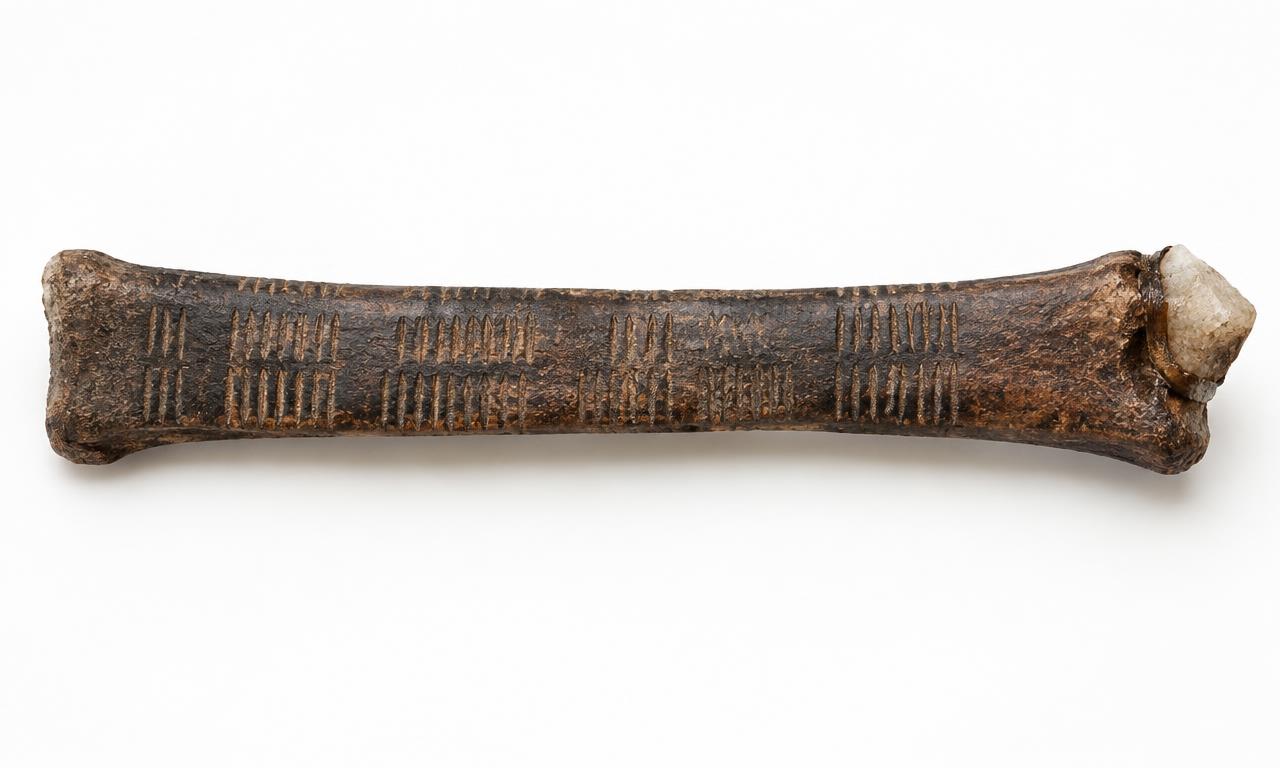
The Ishango Bone, found near Lake Edward in the Democratic Republic of Congo. Its carved notches are about 20,000 years old.

Learning targets

  • I can read tally marks by skip-counting groups of 5 and adding the leftovers.
  • I can record a count with tally marks.
  • I can explain the pattern in a skip-counting sequence.

Standards

3.OA.D.9 Identify arithmetic patterns and explain them using properties of operations.

2.NBT.A.2 Skip-count by 5s, 10s, and 100s (prerequisite review).

Materials

  • Lesson slides (on screen or printed)
  • Student handout (one per student)
  • Craft sticks or pencils (20 per pair) for building tallies
  • Hundred chart (one per pair)
  • Photo of the Ishango Bone (slide 2)
  • Whiteboards and markers

Vocabulary

tally mark:
A line that stands for 1 thing counted.
tally group:
Four lines crossed by a fifth line. One group = 5.
skip-count:
Count forward by the same number each time, such as 5, 10, 15, 20.
total:
How many in all.
artifact:
An object made by people long ago that teaches us about their lives.
Counting in Bone

The story behind the math: Counting in Bone

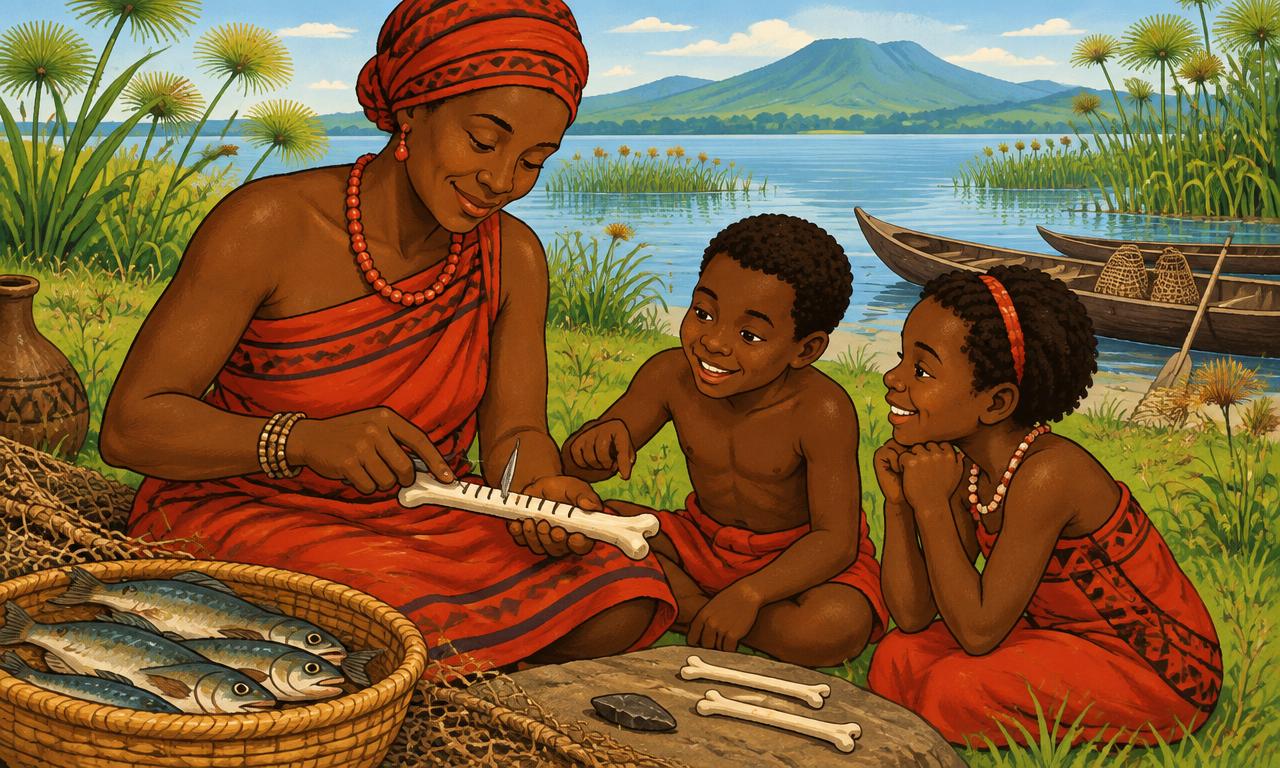
About 20,000 years ago, families lived by the shores of Lake Edward in Central Africa, in what is now the Democratic Republic of Congo. They fished, gathered plants, and watched the moon move across the sky.

Someone in that community picked up a baboon bone and carved small notches into it, one by one, in careful groups. Today we call it the Ishango Bone. It is one of the oldest math tools ever found.

Scientists still debate exactly what the marks counted. They may have tracked days, the moon, or quantities of food. What we know for sure: African people were recording numbers long before anyone wrote numerals on paper. Today, you will count just like they did.

Talk about it

  • Why might a family want to keep track of how many days or how many fish?
  • How do you keep track of things you count at home or at school?

1. Prerequisite Check

5 min

Teacher note: Students answer on whiteboards. Scan for accuracy. Students who miss 2 or more join the small group during Guided Practice.

  1. 1. Skip-count by 5s: 5, 10, 15, ___, ___, ___
  2. 2. Skip-count by 10s: 10, 20, 30, ___, ___
  3. 3. How many dots are shown?
  4. 4. What is 15 + 3?

If students miss 2 or more: Run a 5-minute re-teach with a hundred chart: students color every 5th square and read the colored numbers aloud together. Then return to item 3 with counters.

2. Fluency Drills

7 min

Teacher note: Choral count first, then partners race the sprint for 2 minutes. Celebrate personal bests, not speed rankings.

Choral count

  1. 1. Count by 5s from 0 to 50, clapping on each multiple of 10.
  2. 2. Count by 5s backward from 50 to 0.

Sprint: fill in the missing numbers

  1. 1. 5, 10, ___, 20
  2. 2. 25, 30, ___, 40
  3. 3. 40, 45, ___, 55
  4. 4. ___, 65, 70, 75
  5. 5. 10, 20, ___, 40
  6. 6. 20 + 4 = ___
  7. 7. 35 + 2 = ___
  8. 8. 45 + 3 = ___

3. Direct Instruction

Modeling · I do · 10 min

  1. Say: "When the people of Ishango counted, they carved one notch for each thing. Watch how I make tally marks."
  2. Draw 4 vertical lines while counting aloud: 1, 2, 3, 4. Draw the fifth line across: "The fifth line crosses the group. Now I have one bundle of 5."
  3. Think aloud: "I don't have to count every line. I can skip-count the bundles by 5, then count on the leftovers by 1s."
  4. Point to each bundle while counting 5, 10, 15. Then touch each leftover: 16, 17. "The total is 17."

Example 1: Read a tally

How many notches are shown?

  1. Circle each full bundle of 5.
  2. Skip-count the bundles: 5, 10, 15.
  3. Count on the leftovers: 16, 17.

Answer: 17 notches

Example 2: Use a number line

Show 4 bundles of 5 and 3 more on a number line.

0510152025
  1. Make 4 jumps of 5: 5, 10, 15, 20.
  2. Make 3 small jumps of 1: 21, 22, 23.

Answer: 23

Example 3: Make a tally

Record 12 with tally marks.

  1. Ask: how many 5s fit in 12? 5, 10. That is 2 bundles.
  2. 12 - 10 = 2 leftovers.
  3. Draw 2 bundles and 2 single lines.

Answer: Two bundles and 2 lines

Guided Practice · We do · 10 min

Teacher note: Partners build each tally with craft sticks, then record it. Circulate and ask: "How many bundles? How many leftovers?" Pull the prerequisite small group to the back table.

  1. 1. Read the tally. How many?

    Hint: Skip-count 5, 10, then count on 4.

  2. 2. Build 18 with craft sticks. Draw your tally.

    Hint: How many 5s fit in 18?

  3. 3. Read the tally. How many?

    Hint: Count the bundles first.

Independent Practice · You do · 10 min

Teacher note: Students work alone on the handout. Early finishers try the challenge problem.

  1. 1. How many?
  2. 2. How many?
  3. 3. Draw tally marks for 16.
  4. 4. Draw tally marks for 25.
  5. 5. Complete the pattern: 15, 20, 25, ___, ___, 40
  6. 6. Challenge: Kofi says 3 bundles and 4 lines is 34. Is he right? Explain.

4. Word Problems

10 min

Teacher note: Read each story aloud. Students underline the question, then solve with any model. Share two different strategies for problem 2.

The Fish Count

1. The Fish Count

Long ago by Lake Edward, Mama Nia came home from fishing at sunset. Her son Tembo helped carry the baskets. "Let's keep track so we know how many fish we can share with our neighbors," she said. Tembo carved a notch for every fish.

How many fish did Mama Nia catch?

Amara's Tomato Harvest

2. Amara's Tomato Harvest

On Saturday, Amara went with her granddaddy to the community garden on their block. He grows tomatoes to give to families at church. Amara kept a tally on her clipboard: 3 full bundles in the first basket and 2 full bundles and 4 more in the second basket.

How many tomatoes did they pick in all?

Days Until Kwanzaa

3. Days Until Kwanzaa

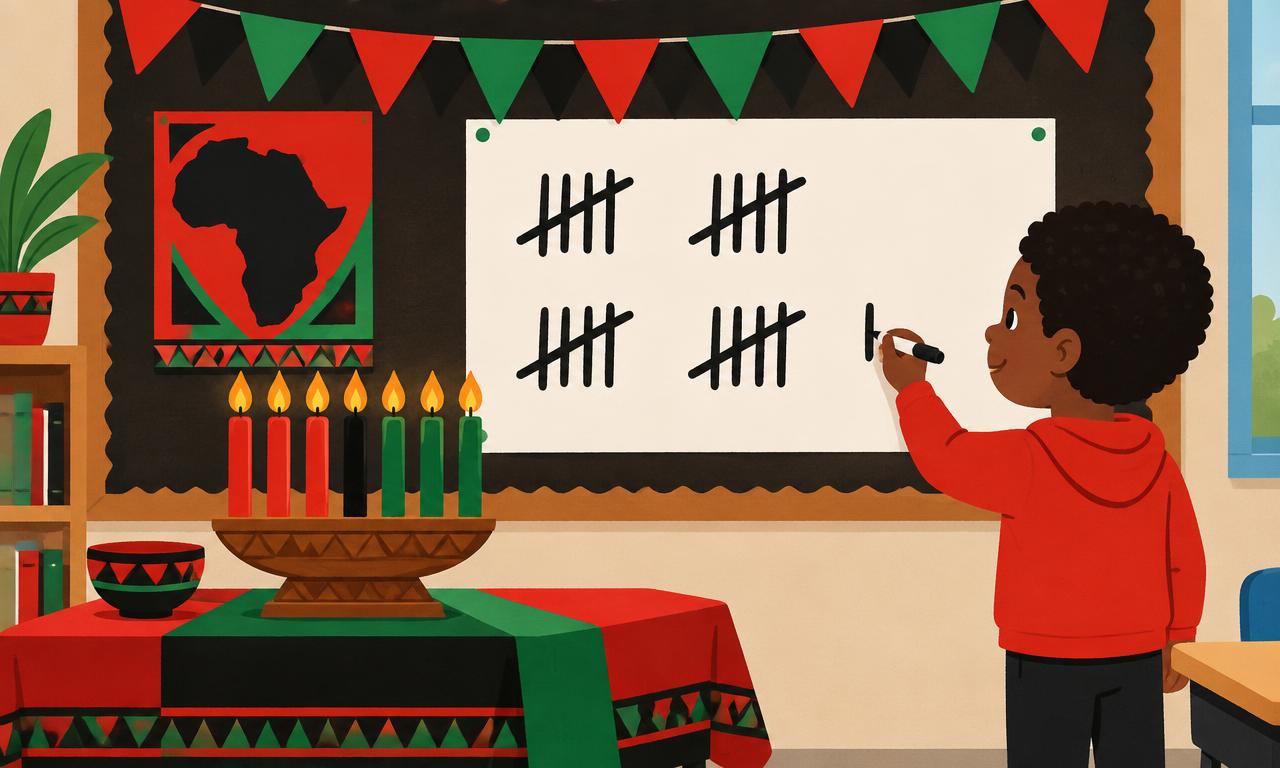
Jalen's class is counting down to their Kwanzaa celebration. Each morning, the class line leader adds one tally mark to the board. The chart now shows 4 full bundles and 1 extra mark. The celebration happens after 30 marks.

How many marks are on the board? How many more marks until the celebration?

STEAM extension: Carve Your Own Counting Stick

Students design a counting stick that records something they care about, such as pages read, days of rain, or plays in a basketball game.

  1. Choose something to count for one week.
  2. Use a craft stick or strip of cardboard. Mark a notch or line for each count, bundling in 5s.
  3. At the end of the week, find the total by skip-counting.
  4. Share: How is your stick like the Ishango Bone? How is it different?

5. Exit Ticket

5 min

1. How many tally marks?

Work space

2. Draw tally marks to show 22.

Work space

3. Explain how skip-counting helps you count tallies faster.

Work space

Scoring: 3 correct = got it; 2 = almost (partner review tomorrow); 0-1 = re-teach in small group.

Differentiation

Support for struggling learners

  • Give students a hundred chart with multiples of 5 highlighted.
  • Provide craft sticks so students build every tally before drawing it.
  • Limit independent practice to problems 1-4.
  • Use sentence frames: "I see ___ bundles. That is ___. Plus ___ more is ___."

English learners

  • Pre-teach vocabulary with pictures: tally, bundle, total, artifact.
  • Pair students with a language buddy for the word problems.
  • Let students answer in their home language, then restate the number in English.

Extension for advanced learners

  • Record totals over 50 using tallies. Find a faster way to count bundles of bundles (10s).
  • Compare with the Yoruba counting system, which uses groups of 20.
  • Write your own tally story problem for a classmate.

Accommodations (IEP / 504)

  • Enlarge diagrams for students with visual impairments.
  • Allow oral answers or scribe for students with fine-motor needs.
  • Chunk the handout: give one section at a time.

Small-group plan: During Guided Practice, meet with students who missed 2+ prerequisite items. Use counters to build groups of 5 and count by 5s together before drawing tallies.